

At Vision Care Clinic, one of the most common questions patients ask is, “What do those numbers on the eye chart actually mean?” Whether you’re considering laser vision correction, or exploring cataract surgery, understanding visual acuity or quality of vision and refraction can help you better understand your eye sight and eye health.
Visual acuity is a measurement of how clearly you can see details at a specific distance. It evaluates the sharpness of your vision and provides an important indication of how well your eyes are functioning.
During a standard eye examination, visual acuity is typically measured using a Snellen chart, the familiar wall chart displaying rows of letters that gradually decrease in size.
It is important to remember that visual acuity measures clarity of vision, but it does not provide a complete assessment of eye health. A patient may have excellent visual acuity while still having underlying eye conditions that require attention.
The Snellen chart was developed by Dutch ophthalmologist Hermann Snellen in the 1860s and remains one of the most widely used methods of measuring visual acuity today.
The chart consists of:
- Large letters at the top
- Progressively smaller letters on each lower line
- Standardised spacing between letters and rows
- A predetermined testing distance
In the United Kingdom, testing is often performed at 6 metres, while in the United States the standard testing distance is 20 feet. These distances are sufficiently long that the eye’s focusing effort is minimal, allowing for a reliable measurement of distance vision.
Patients are asked to read the smallest line they can see comfortably, first with one eye covered and then the other.
Understanding 6/6 Vision
In the UK and many other countries, visual acuity is expressed as a fraction, such as 6/6, 6/9, or 6/12.
The first number refers to the testing distance, which is usually 6 metres.
The second number represents the distance at which a person with normal vision could read the same line.
For example:
- 6/6 vision means you can read at 6 metres what a person with standard vision should read at 6 metres.
- 6/12 vision means you must be 6 metres away to read what a person with normal vision could read from 12 metres away.
- 6/5 vision is better than average, allowing you to see more detail than the standard 6/6 benchmark.
Understanding 20/20 Vision
In the United States, visual acuity is commonly expressed as 20/20 rather than 6/6.
The principle is exactly the same:
- 20/20 is equivalent to 6/6
- 20/40 is equivalent to approximately 6/12
- 20/15 is equivalent to approximately 6/4.5
The difference is simply the unit of measurement. Americans use feet, whereas most other countries use metres.
Patients are often pleased to learn that achieving better than 6/6 vision is possible following successful refractive procedures or lens-based surgery, depending on individual circumstances.
While visual acuity tells us how clearly you see, refraction helps us understand why you see that way.
Refraction is the process of determining the optical prescription needed to focus light accurately onto the retina.
During a refraction assessment, an optometrist or ophthalmologist measures whether you are:
- Short-sighted (myopic)
- Long-sighted (hyperopic)
- Astigmatic
- Affected by age-related reading difficulties (presbyopia)
Using specialised lenses, the clinician determines which prescription provides the sharpest and most comfortable vision.
Many patients will recognise the familiar question:
“Which is clearer, number 1 or number 2?”
This process allows the examiner to fine-tune the prescription until the best possible visual acuity is achieved.
Visual acuity and refraction are closely linked but measure different things.
Think of visual acuity as the result, and refraction as the tool used to improve that result.
For example:
A patient may initially have visual acuity of 6/18 without glasses. During refraction testing, the clinician identifies a prescription that improves vision to 6/6. The visual acuity has improved because the refractive error has been corrected.
Sometimes, however, visual acuity cannot be improved to 6/6 despite the best prescription. When this occurs, additional investigation may be necessary to identify underlying causes such as:
This is one reason why comprehensive eye examinations are so important.
Precise measurements of visual acuity and refraction are fundamental to modern eye care. They help clinicians:
- Diagnose vision problems
- Prescribe accurate glasses or contact lenses
- Monitor eye health over time
- Assess suitability for laser eye surgery
- Evaluate cataract surgery outcomes
- Track the effectiveness of treatment
At Vision Care Clinic, these assessments form part of a comprehensive approach to understanding not only how well you see, but why you see the way you do.
Understanding the relationship between visual acuity and refraction can help patients make informed decisions about their eye care, whether they require glasses, contact lenses, laser vision correction, or other care.
Published 28th July 2026
by Rebecca
by Rebecca
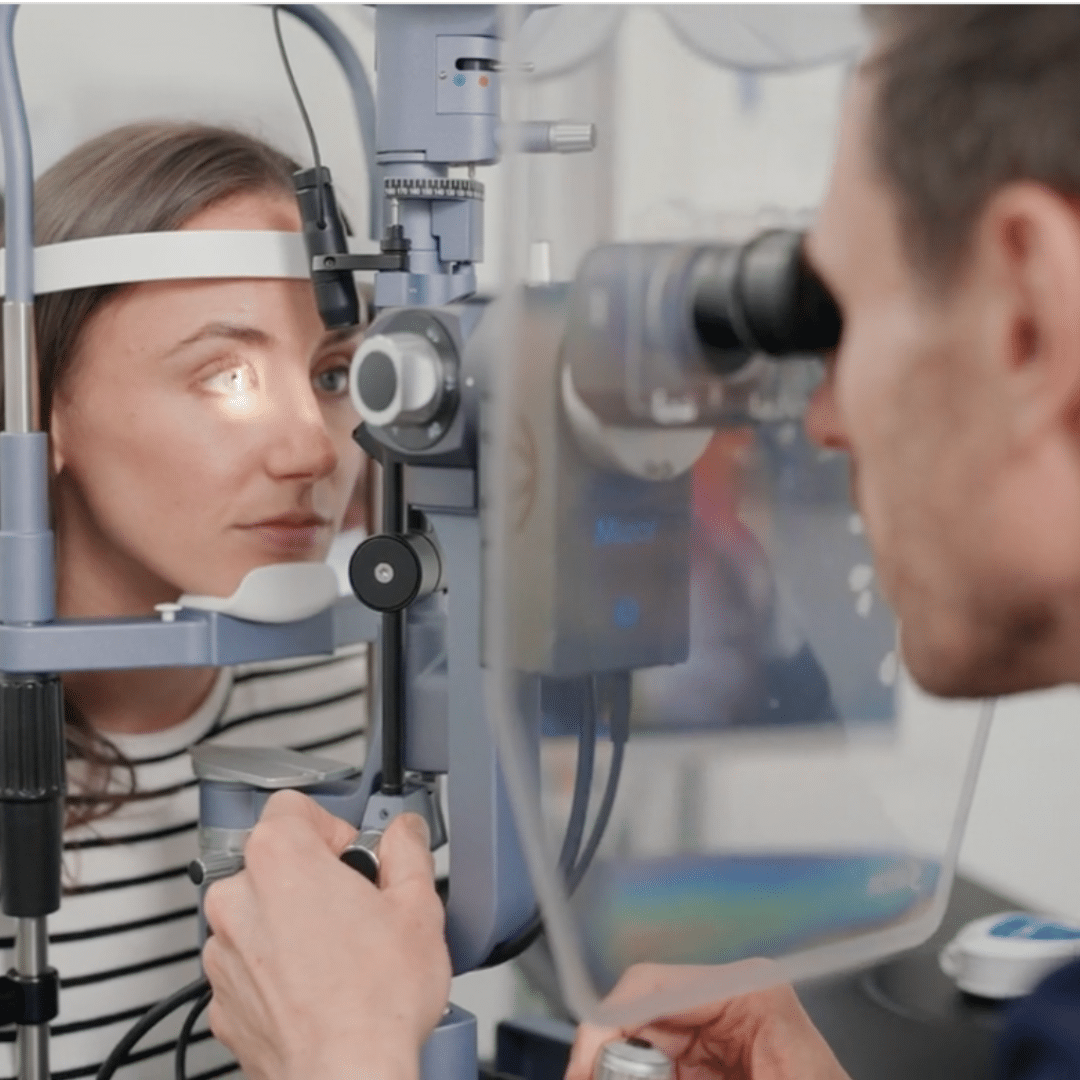
At Vision Care Clinic, one of the most common questions patients ask is, “What do those numbers on the eye chart actually mean?” Whether you’re considering laser vision correction, or exploring cataract surgery, understanding visual acuity or quality of vision and refraction can help you better understand your eye sight and eye health.
You might be interested in:
How to Manage Dry Eyes
Dry eyes are one of the most common, and frustrating, eye complaints, affecting millions of people every day. Whether caused by prolonged screen use, environmental factors, or underlying eye conditions, the burning, gritty, and tired sensations can make even simple tasks uncomfortable. If you’ve tried endless drops with little success, you’re not alone.
Read More
Does Laser Eye Surgery Hurt?
If you’re considering correcting your vision with LASIK or another type of laser eye surgery, one of the most common concerns is: does laser eye surgery hurt? The good news is laser eye surgery is performed, pain-free.
Read More
Frequently Asked Questions About Laser Eye Surgery
At Vision Care Clinic, many of our patients are curious about the procedure, its benefits, and what to expect. To help you feel informed and confident, we’ve compiled answers to some of the most frequently asked questions about laser eye surgery.
Read More